
Guides
GN Pan Depths: 20, 40, 65, 100, 150 and 200 mm
Gastronorm fixes eight footprints and six depths. Buyers spend most of their time on the footprint, then pick a depth almost by accident — and depth is the choice that decides whether the pan holds temperature, passes a cooling window and fits the oven. This is what each of the six depths is actually for.
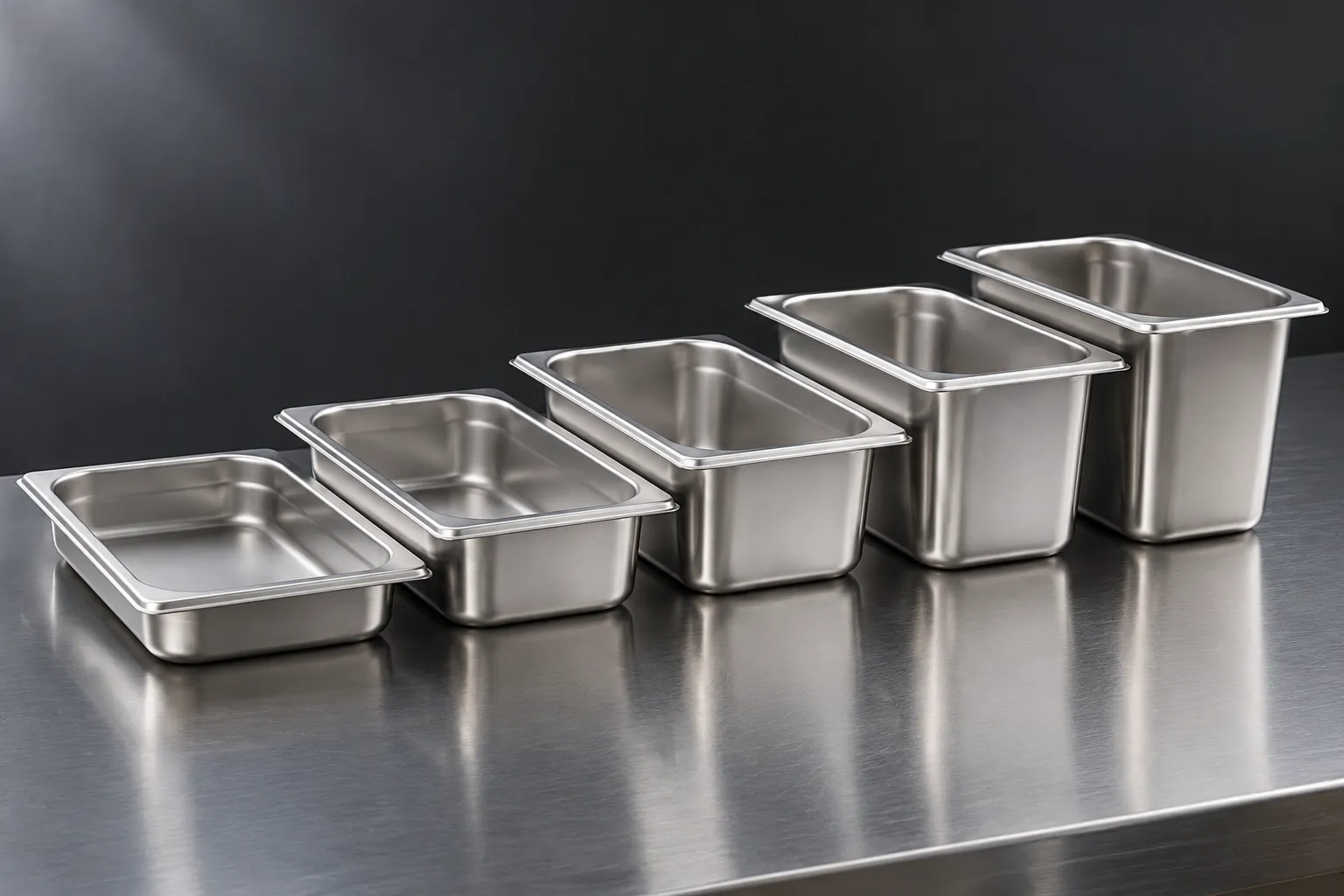
The six depths at true scale
Drawn in proportion — one unit per millimetre of depth. The footprint is identical in every case, so the only thing changing is the drop below the rim.
Litre figures are nominal brim-full capacity for a GN 1/1 pan. Gastronorm fixes the footprint and the depth but not the taper angle or corner radius, so real capacity moves a few percent between manufacturers.
What each depth is for
20 mm
Display and garnish2.7 L at GN 1/1Cut fruit, garnishes, single layers of prepared items on a chilled display. Nothing that needs stirring.
Too shallow to hold temperature for long. Refresh it often or keep it on active refrigeration.
40 mm
Toppings and cold rails5.4 L at GN 1/1Sauces, pickles, cheese and topping rails where a cook reaches in continuously through a service.
The most comfortable depth to work out of by hand. A cook's wrist does not have to drop below the counter line.
65 mm
The default8.8 L at GN 1/1Hot holding, service, combi cooking, general prep. If there is no reason to choose otherwise, choose this.
Matches the standard rack pitch in most combi ovens, so a full oven load is 65 mm pans on every level.
100 mm
Soups, sauces, bulk13.7 L at GN 1/1Liquids and braises held in volume, or bulk product moving from production to a service counter.
Usually skips a rack level in a combi oven. Count the levels you actually lose before specifying it.
150 mm
Storage and brining20.0 L at GN 1/1Walk-in storage, marinating, brining, and transporting prepared product between kitchens.
Heats and chills slowly. Treat it as a storage format, not a cooking or holding one.
200 mm
Deep storage27.8 L at GN 1/1Bulk dry goods, large-batch brining, and transport where volume per pan matters more than anything else.
Rarely appropriate for service. A full 200 mm GN 1/1 of liquid is heavy enough to be a two-person lift.
Depth by station
| Station | Depth | Why |
|---|---|---|
| Salad bar / cold rail | 40 mm | Reachable all service without the cook bending, and product turns over fast enough that depth is not needed |
| Hot holding counter | 65 mm | Enough volume for a service without the cold centre that deeper pans develop in a bain marie |
| Combi oven cooking | 65 mm | Fits the standard rack pitch, so the oven runs at full level count |
| Sauce and soup holding | 100 mm | Liquids hold their temperature better than solids, so the depth penalty is smaller here than anywhere else |
| Walk-in storage | 150 mm | Nothing is being served from it, so slow thermal response does not matter and floor space does |
| Blast chilling | 20–40 mm | Cooling time is set by the thickest point of the product; shallow is the only way to pass a cooling window |
Why depth is a thermal decision
Volume grows faster than heated area
Going from 65 mm to 150 mm on a GN 1/1 takes the pan from about 8.8 litres to about 20 — well over double the product. The base area heating it has not changed at all. Every extra millimetre of depth adds product behind the same heated surface.
In a bain marie that produces the familiar failure: a hot base, a cool middle, and a skinned top. Stirring masks it for a few minutes. Raising the well temperature makes the base worse without fixing the centre. The only structural fix is less depth.
Chilling is governed by the thickest point
Cooling is not set by the air temperature or the rating on the blast chiller. It is set by how far heat has to travel out of the deepest part of the product. Doubling the depth of the product roughly quadruples the time the centre takes to reach temperature.
This is why a kitchen that keeps failing its cooling window usually does not need a bigger chiller. It needs to stop cooling in 150 mm pans. Splitting the same batch across shallow pans is the cheapest fix available in a commercial kitchen.
Depth costs oven levels
Combi ovens are built around a rack pitch that suits 65 mm pans. That is not a coincidence — the pitch and the depth were designed together. A 100 mm pan generally occupies the space of two levels, and a 150 mm pan more.
A twenty-level oven running 100 mm pans is a ten-level oven. Work that out on the equipment schedule before the kitchen is built, because it changes how much oven the menu actually needs.
Rules that hold up in a real kitchen
- 65 mm unless there is a specific reason to choose otherwise
- Shallow and refreshed beats deep and filled once, for anything hot
- Never chill in anything deeper than 40 mm
- Count the oven levels a deep pan costs before specifying it
- Match the depth to the well depth on the equipment schedule, not to the volume you wish you had
Frequently asked questions
What are the standard gastronorm pan depths?
EN 631-1 defines six standard depths: 20, 40, 65, 100, 150 and 200 mm. Every standard footprint from GN 2/1 down to GN 1/9 is produced in some subset of these. The very small formats, GN 1/6 and GN 1/9, stop before the deepest sizes because a pan that narrow and that deep cannot be emptied or cleaned properly.
What is the most common GN pan depth?
65 mm. It is the default for hot holding, service and combi oven cooking, and it matches the rack pitch of most combi ovens so a full load can be 65 mm pans on every level. If a specification does not state a depth, 65 mm is almost always what was meant.
How deep is a GN 1/1 pan?
A GN 1/1 pan has a fixed 530 by 325 mm footprint and is made in all six standard depths. Brim-full capacity runs from about 2.7 litres at 20 mm to about 27.8 litres at 200 mm. The footprint never changes; only the depth and therefore the volume do.
Should I use one deep pan or two shallow pans?
Two shallow pans, in almost every case where the product is hot or being chilled. Doubling depth roughly doubles capacity but slows how quickly heat enters and leaves, so a deep pan holds unevenly and chills slowly. Cooling time is governed by the thickest point of the product, so a batch split across two shallow pans will pass a cooling window that one deep pan misses. Use a deep pan when the product is being stored rather than held or cooled.
Will a 100 mm pan fit in a combi oven?
It fits, but it usually costs you a rack level. Most combi ovens are built around a rack pitch that suits 65 mm pans, so a 100 mm pan occupies the space of two levels. Before specifying deep pans for oven use, count how many levels the oven actually loses and whether the remaining capacity still covers peak service.
Do deeper pans fit standard steam table wells?
Most steam table and bain marie wells are built to accept up to 150 mm, and many take 200 mm. The limit is rarely the well itself but the water level and the heat transfer: a very deep pan sits with more of its volume above the heated zone, so the top of the product runs cooler than the bottom. Check the well depth on the equipment schedule rather than assuming.
Why does a deep pan hold heat unevenly?
A deeper pan holds more volume behind the same heated surface area, so the distance heat has to travel from the base to the surface grows. In a bain marie that shows up as a hot base, a cool centre and a crusted top. Stirring hides it temporarily. The structural fix is a shallower pan refreshed more often, not a hotter well, because raising the well temperature damages the product nearest the base.
Are there non-standard gastronorm depths?
Yes. Some manufacturers produce intermediate depths such as 55, 110 or 120 mm, usually to suit a particular piece of equipment. They fit the standard footprint and will drop into any standard opening, but replacements are harder to source and lids and accessories may not match. Specify a standard depth unless a piece of equipment genuinely requires otherwise.
Does depth affect how pans stack and nest?
Shallow pans nest tightly and store in a fraction of the space, which is why prep kitchens run out of shallow pans first. Deep pans nest too, but the stack becomes tall and unstable well before it becomes heavy. If storage height is limited, that constrains how many deep pans you can realistically keep in circulation.
Which depth should I use for blast chilling?
20 or 40 mm. Blast chilling is governed entirely by the thickest point of the product, not by the air temperature or the machine's rating. Spreading a batch across shallow pans is the single most effective way to pass a cooling window, and it is usually cheaper than a larger blast chiller.
GN pans from COMMI
COMMI manufactures gastronorm pans in stainless steel and PESU high-heat polymer across the standard footprints and all six standard depths.