
Guides
How Many GN Pans Fit: Ovens, Bain Maries and Counters
Equipment capacity is quoted in gastronorm pans because every opening in a commercial kitchen is built to the same 530 × 325 mm module. That makes the arithmetic predictable — right up to the point where depth enters it, and a ten-level oven quietly becomes a five-level one.
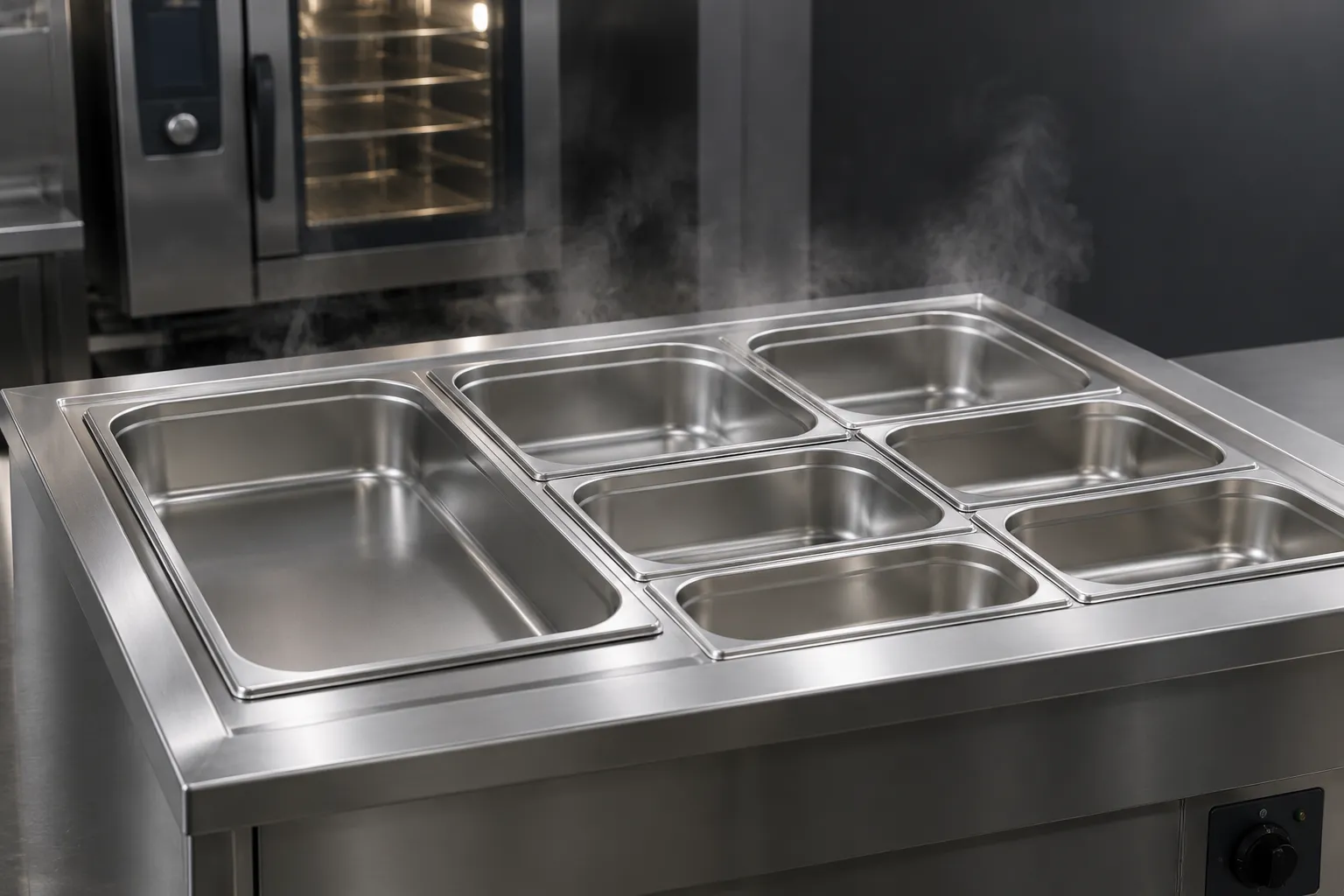
What fills one GN 1/1 opening
Every gastronorm fraction is defined so it tiles back into the module without gaps. This is why equipment capacity can be stated in pans at all, and why mixing sizes in one counter works.
1 × GN 1/1
The module itself — 530 × 325 mm
2 × GN 1/2
Split across the long side
3 × GN 1/3
The most common service split
4 × GN 1/4
Condiments and garnish rails
6 × GN 1/6
Topping rails and sauce stations
9 × GN 1/9
Small garnish, the practical minimum
1 × GN 2/3 + 1 × GN 1/3
One large plus one small in the same opening
1 × GN 1/2 + 2 × GN 1/4
Mixed rail, common on saladettes
Where the oven levels go
Both cavities below are the same height, drawn to scale at one unit per millimetre. The only difference is the depth of the pan going into them.
Illustrative at a 700 mm cavity on a 70 mm rack pitch, which is representative rather than universal. Rack pitch varies between manufacturers — read it off the oven datasheet before committing to a pan depth.
Capacity by equipment type
Combi oven — 6 × GN 1/1
6 pans at 65 mmThe standard small-kitchen oven. Six levels on a rack pitch built around 65 mm pans. Running 100 mm pans typically halves it to three usable levels.
Combi oven — 10 × GN 1/1
10 pans at 65 mmThe workhorse size for a restaurant doing real volume. Ten levels at 65 mm, or roughly five at 100 mm.
Combi oven — 20 × GN 1/1
20 pans at 65 mmRoll-in trolley oven for banqueting and central kitchens. A 20 × GN 2/1 version doubles the area per level again.
Bain marie — 2 well
2 × GN 1/1, or up to 6 × GN 1/3Each well takes one GN 1/1 opening, so it also takes any combination that tiles back into it. Well depth usually accepts up to 150 mm.
Bain marie — 3 or 4 well
3–4 × GN 1/1, or 9–12 × GN 1/3Standard service counter. Mixing sizes across wells is normal — one full pan of rice beside three thirds of curry.
Saladette / prep counter
Typically 5–9 × GN 1/6 or 1/3 in the topThe chilled top is specified in GN fractions, not in litres. Count the openings on the drawing; manufacturers differ by a pan or two at the same overall width.
Blast chiller — 5 × GN 1/1
5 pans, and use 20–40 mmRated capacity assumes shallow pans. Loading 100 mm pans does not just cut the count, it pushes the cycle past the cooling window.
Banquet / transport trolley
10–20 × GN 1/1 depending on pitchPitch varies far more than on ovens. Check the runner spacing on the trolley against the depth you actually plan to move.
Five ways this goes wrong
Reading oven capacity as pan capacity
A 10 × GN 1/1 oven holds ten levels, not ten pans of any depth. Deep pans consume more than one level each.
Sizing a bain marie by litres
Wells are specified in GN openings. Litres depend on which pans you drop in, and that can change every service.
Assuming every 1/6 pan set fills the counter
Two saladettes of the same external width can differ by two openings. Count them on the equipment drawing.
Buying pans before the equipment schedule is final
Pans are cheap to reorder in the right fractions and expensive to store in the wrong ones. Fix the openings first.
Ignoring lid clearance above a well
A notched lid or a hinged lid needs headroom the pan itself does not. Sneeze guards and gantries are where this bites.
Sizing a line from the menu backwards
Start from openings, not from equipment
Count the distinct products that have to be held at once during peak service. That number is your opening count, before anything is bought. A line holding rice, three curries, two pickles and a yoghurt needs seven openings — which is one GN 1/1 plus two 1/1 openings split into thirds, or a four-well counter tiled properly.
Buying the counter first and then discovering it holds five products is the most common and most expensive sequencing error in a kitchen fit-out.
Then decide refresh rhythm, then depth
Once you know the openings, work out how often each product will be refreshed. A product refreshed twice a service can sit in a shallow pan and will taste better for it. A product that has to last the whole service needs the volume, and that is where depth earns its place.
Doing it in this order means depth is a deliberate choice on two or three stations rather than a default applied to all of them.
Buy pans last
Pans are the cheapest item on the schedule and the easiest to reorder. Openings, rack pitch and well depth are fixed once the equipment lands. Fix the equipment against the menu, confirm the openings on the drawing, and only then order the fractions and depths that fill them.
Quick rules
- A pan rating is a level count at 65 mm — confirm the depth it was measured at
- Bain marie and counter capacity is openings, not litres
- Count openings on the equipment drawing, never from external width
- Chill in 20–40 mm pans or the rated cycle time does not apply
- Fix the equipment first, order the pan fractions second
Frequently asked questions
How many GN 1/1 pans fit in a 10-grid combi oven?
Ten, at 65 mm depth. The rack pitch on a combi oven is built around 65 mm pans, so the grid count and the pan count match only at that depth. At 100 mm you generally get about five, and at 150 mm fewer again, because each pan occupies more than one rack level.
How many GN 1/3 pans fit in one GN 1/1 opening?
Three. The gastronorm fractions are defined so they tile back into the GN 1/1 module without gaps — three 1/3 pans, two 1/2 pans, four 1/4 pans, six 1/6 pans or nine 1/9 pans all fill one 530 by 325 mm opening. You can also mix, for example one GN 2/3 alongside one GN 1/3.
How many pans does a 3-well bain marie hold?
Three GN 1/1 openings, so three full pans — or any tiling combination of them, which usually means up to nine GN 1/3 pans. Wells are specified by opening, not by volume, so the litre capacity of the counter changes with whichever pans you drop in.
Does pan depth change how many fit?
In an oven, a chiller or a trolley, yes — those are governed by rack pitch, so a deeper pan consumes more than one level. In a bain marie or a counter top, no: depth does not change the footprint, so the number of openings is the same. What changes there is whether the well is deep enough to take the pan at all.
What is the GN 1/1 module?
530 by 325 mm, defined by EN 631-1. Every other gastronorm size is a fraction or a multiple of it, and equipment openings across the industry are built to it. That is why a pan bought in one country drops into a counter built in another, and why equipment capacity can be stated in pans at all.
How many GN pans fit in a blast chiller?
A 5 × GN 1/1 blast chiller holds five levels, but the rated cycle time assumes shallow pans. Cooling is governed by the thickest point of the product, so loading deep pans does not simply reduce the count — it can push the cycle past the cooling window the machine was specified to meet. Chill in 20 to 40 mm pans.
Can I mix GN sizes in the same opening?
Yes, and most service counters do. Any combination that tiles back into the module works: one GN 2/3 with one GN 1/3, or one GN 1/2 with two GN 1/4. Mixing is normal practice on a service line — one large pan of a staple beside several small pans of accompaniments.
Why do two counters of the same width hold different numbers of pans?
Because the internal opening layout differs even when the external dimension does not. Manufacturers vary the well spacing, the frame width and the insulation thickness. Count openings on the equipment drawing rather than inferring them from the overall width on the datasheet.
Equipment and pans from COMMI
COMMI supplies the counters, ovens and refrigeration alongside the gastronorm pans that fill them — and will size the openings against your menu before anything is quoted.