
Guides
GN Pan Lids: Flat, Notched, Sealed and Hinged
A lid is specified against the opening, not the pan — which is why a GN 1/3 lid fits almost any GN 1/3 pan, and why kitchens accumulate lids that technically fit and are still the wrong ones. The four types do genuinely different jobs.
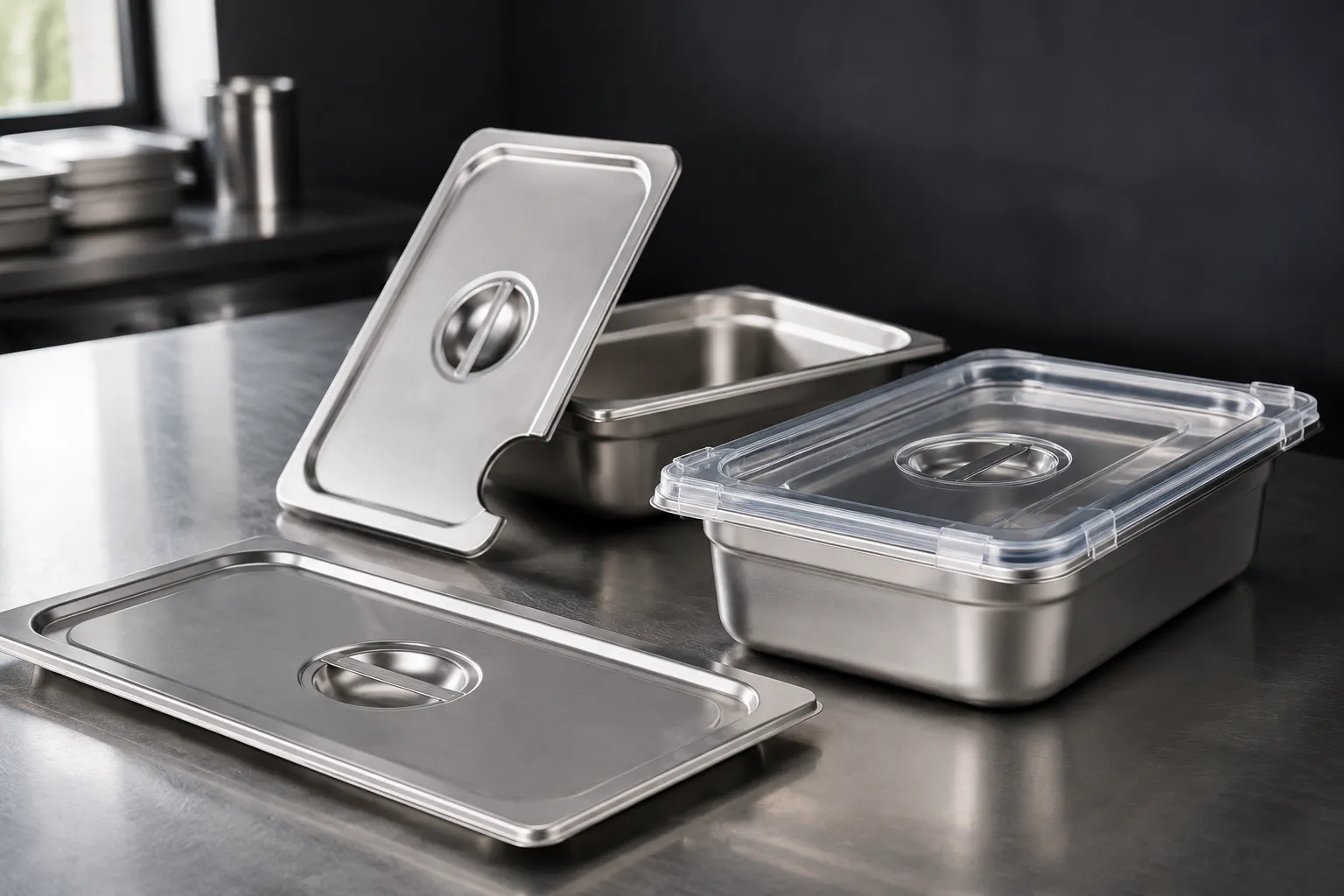
The four types
Flat lid
Transport and storageStainless steelA plain covering lid with a recessed handle. Closes the pan completely and stacks flat under another pan.
Against it: No utensil cut-out, so it has to come off entirely to serve. Wrong choice for an active service line.
Notched lid
Active serviceStainless steel or polycarbonateA cut-out in one edge lets a ladle or spoon handle stay in the pan with the lid closed. The default on any hot line.
Against it: The notch is a permanent opening. It holds temperature far less well than a flat lid and is not a seal.
Sealed lid
Storage and transport of liquidsPolycarbonate or polypropylene with a silicone gasketA gasket in a channel around the rim compresses against the pan flange. Holds liquid through a trolley run and stops fridge odour transfer.
Against it: The gasket is a consumable and a hygiene risk if it is not removed for cleaning. Check it is designed to come out.
Hinged lid
High-frequency accessStainless steelSplits across the middle so half lifts while the other half stays down. Keeps most of the pan covered during service.
Against it: More moving parts, more to clean, and the hinge is the first thing to fail in a commercial dishwasher.
Which lid for which job
| Situation | Lid | Why |
|---|---|---|
| Hot holding on a service line | Notched | The serving utensil stays in the pan; the lid stays on between portions |
| Moving soup between kitchens | Sealed | A gasket is the only one of the four that genuinely holds liquid at an angle |
| Walk-in storage, stacked | Flat | Flat is the only profile another pan sits on squarely without rocking |
| Buffet with constant access | Hinged | Half the pan stays covered even while a guest is serving themselves |
| Blast chilling | None | A lid traps the heat you are trying to remove; cover after the cycle, not during |
What actually wears out
Gaskets fail silently
Silicone hardens with repeated heat cycling. A gasket that has been through a commercial dishwasher several hundred times will still look intact and will have stopped compressing properly long before that. Nothing tells you except a spill on a trolley.
Treat gaskets as consumables with a replacement interval, the same way you treat door seals on refrigeration. Order them with the lids so the replacements exist before anyone needs them.
Polycarbonate crazes before it cracks
Clear lids lose optical clarity gradually under commercial wash chemistry — a fine network of surface cracks that scatters light. The lid is still structurally sound, but the reason it was specified, seeing the product without lifting it, has gone.
If clarity is the point, budget for replacement on a cycle. If it is not, a stainless lid outlives several polycarbonate ones.
Hinges are the weak point
A hinged lid has the only moving joint in the set, and it lives in a hot, wet, chemically aggressive environment while being handled constantly. It is the first component to fail and rarely worth repairing. Specify hinged lids only where the access frequency genuinely justifies them, which in practice means buffets and little else.
Ordering rules
- Specify the lid against the opening, not against a brand of pan
- Notched for anything being served from; flat for anything being stored
- Only a gasketed lid holds liquid at an angle — the other three do not
- Check the gasket is removable before the order, not after delivery
- Count service lids and storage lids separately; they are different populations
Frequently asked questions
What are the different types of gastronorm lid?
Four are in common use. Flat lids cover the pan completely and stack. Notched lids have a cut-out so a serving utensil handle can stay in the pan. Sealed lids carry a silicone gasket that compresses against the flange to hold liquid. Hinged lids split across the middle so half can be opened without removing the lid. Each suits a different point in the workflow rather than being better or worse in general.
Do GN lids fit any brand of pan?
Usually, because the lid is made to the standard opening rather than to a specific pan. Gastronorm fixes the top footprint, so a GN 1/3 lid should sit on any GN 1/3 pan. Sealed lids are the exception worth checking: a gasket needs a consistent flange profile to compress against, and flange thickness is the part of the pan the standard leaves most room around.
What is the notch in a gastronorm lid for?
It lets the handle of a ladle, spoon or tong stay in the pan while the lid is closed. Without it the utensil has to be lifted out and put somewhere every time, which either contaminates a work surface or means the lid never goes back on. On a hot line the notched lid is what makes covering the pan realistic during service.
Does a notched lid keep food hot?
Much better than no lid, and much worse than a flat one. The notch is a permanent opening, so steam escapes continuously and the pan loses heat through it all service. It is a working compromise, not a seal. Where holding temperature genuinely matters and the pan is not being served from, use a flat lid.
Are sealed GN lids airtight?
They are liquid-tight rather than airtight, and only while the gasket is in good condition. A compressed silicone gasket will hold soup through a trolley run and stop odour transfer in a fridge. It will not hold a vacuum, and a gasket that has been through hundreds of dishwasher cycles will have hardened and stopped sealing long before it looks worn.
Can GN lids go in a commercial dishwasher?
Stainless lids, yes, indefinitely. Polycarbonate lids survive commercial wash cycles but clarity degrades over time and they will eventually craze. Sealed lids need the gasket removed for cleaning — if a gasket is not designed to come out, food debris collects in the channel behind it, and that is a hygiene finding waiting to happen.
Do lids affect how pans stack?
Yes, and it is the practical reason kitchens end up with mismatched lids. A flat lid gives another pan a level surface to sit on. A notched lid does not, and a hinged lid definitely does not. If pans are stored stacked and covered, the lid type decides whether the stack is stable.
Should I put a lid on a pan going into a blast chiller?
No. A lid traps exactly the heat the cycle is trying to remove, and blast chilling is already governed by the slowest point in the product. Chill uncovered in a shallow pan, then cover once the product is down to temperature and moving into storage.
How many lids should I order per pan?
Fewer than one to one for service pans and closer to one to one for storage pans. Pans on a hot line are refilled far more often than they are covered, while pans in a walk-in are covered permanently. Counting the two populations separately is what stops a kitchen buying a lid for every pan and still running short in the fridge.
GN pans and lids from COMMI
COMMI supplies gastronorm pans in stainless steel and PESU high-heat polymer with matching flat, notched and sealed lids across the standard footprints.