
Restaurant station buying guide
Sauce portion-control dispensers: how to choose for your restaurant
By COMMI · Updated
Choose a sauce dispenser by the recipe’s portion size, the sauce’s flow and the operator’s movement at the station. A fixed pump and a handheld dispenser can both serve measured portions, but their counter layout, refill routine and cleaning requirements differ.
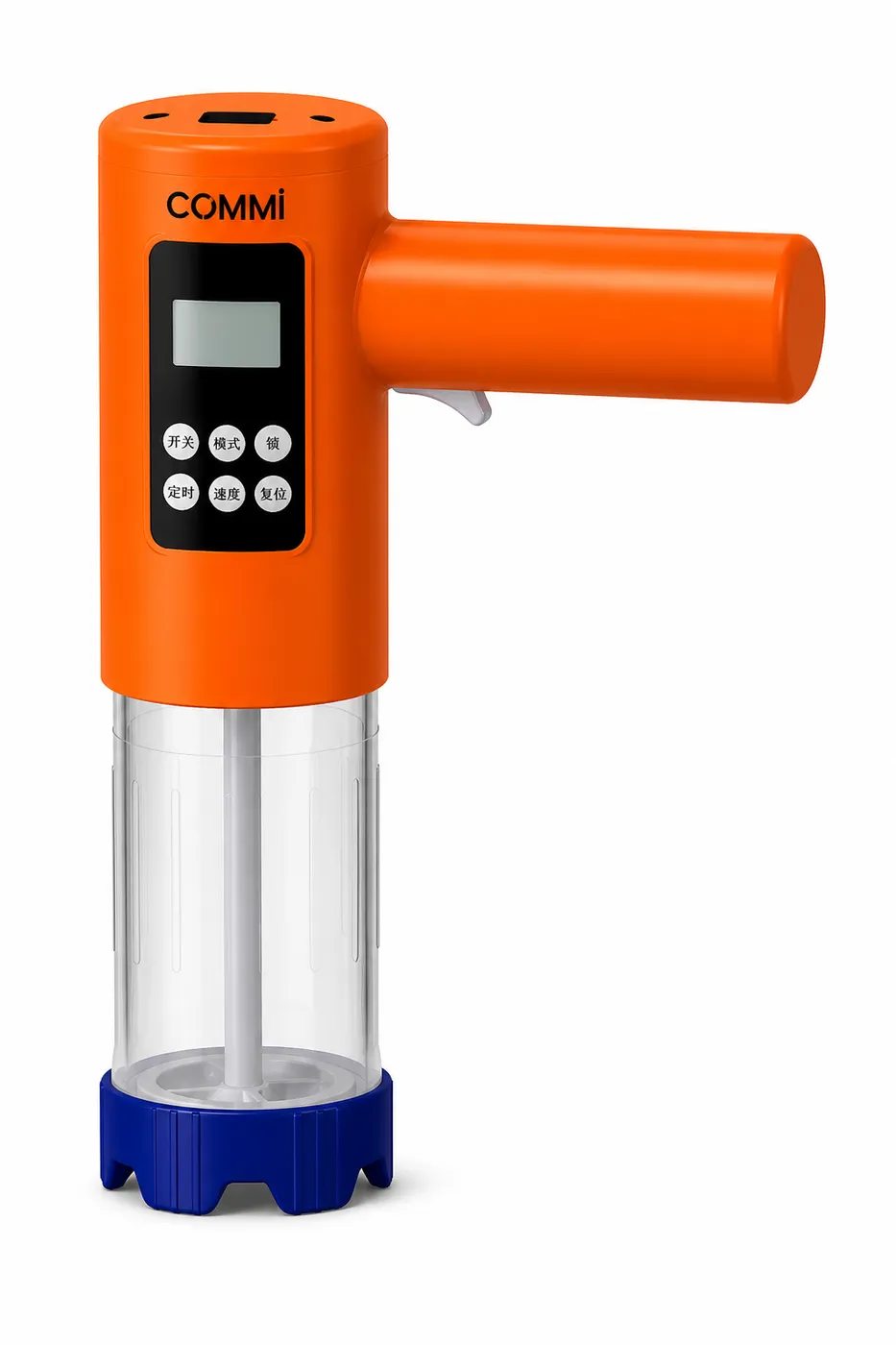
COMMI handheld configuration
The listed COMMI-SM-A / SM-B specification includes a 3–20 ml portion range and a 300 ml bottle. Top-trigger and bottom-trigger configurations let the team compare hand position at its own assembly station.
See current COMMI sauce machine specificationsCompare the dispensing formats
| Format | Station task | What to test |
|---|---|---|
| Free-squeeze bottle | Sauce applied by hand pressure | Measure operator variation and whether the recipe needs a fixed dose. |
| Fixed portion pump | Sauce supplied from one counter position | Check dose adjustment, container fit, reach and the actual sauce flow. |
| Handheld portion dispenser | Measured sauce application over food during assembly | Check filled weight, trigger position, refill access and charging if powered. |
Run a station trial before a rollout
- Set the recipe target. Record the intended dose and unit, sauce name, working temperature and whether it contains particles. Do not convert grams to millilitres without a density measurement.
- Check repeated portions. Prime the dispenser according to its instructions, collect repeated doses and record the results. Repeat with different operators and as the bottle empties; agree on an acceptable range for the recipe.
- Observe the full service task. Include reaching, moving over the food, reloading, stopping and setting the dispenser down. Compare Model A’s top trigger with Model B’s bottom trigger using the same sauce and work position.
- Plan refills and charging. Divide usable fill by portion volume to estimate doses per refill. A nominal 300 ml fill divided by a 10 ml portion is 30 theoretical doses; residue, priming and usable fill can reduce that count.
- Review cleaning and documents. Request the exact model’s disassembly, food-contact and cleaning instructions. Confirm which parts can enter a dishwasher and how powered parts are protected. Ask for destination-specific compliance documents.
Estimate savings without assuming a result
Use measured sauce consumption per comparable order before and during the trial. As an illustration, avoiding 2 ml of over-portioning on 1,000 orders equals 2 litres. That is an arithmetic example, not a COMMI test result. Multiply the measured volume saved by your sauce cost per litre, then account for cleaning time, refills and consumables.
What to send with a quotation request
Send the sauce recipe or sample details, target portion, orders per service period, station layout, preferred trigger style, quantity and destination country. COMMI manufactures its Solution range and supports customisation; the team confirms feasible changes, current specifications, lead time and pricing in the quotation.
Discuss a sauce dispenser station trial and quotationCompare the COMMI sauce dispenser configurations
Compare the listed specifications, then confirm fit and the current drawing for your station. Ask for compliance documents for the exact model and destination market.
Read the sauce portion-control dispenser buying guideBrowse all COMMI Solution station productsSauce dispenser buying questions
What is a sauce portion-control dispenser?
It is a dispenser intended to deliver a selected volume of sauce per operation. A restaurant chooses the target dose for its recipe, then checks the actual delivered amount with its sauce at the working temperature. The mechanism may be a portion pump or a handheld dispenser; a free-squeeze bottle alone does not define a fixed dose.
How do I choose between a sauce pump and a handheld dispenser?
Check where the operator needs the sauce. A fixed pump suits a station where the container stays in one position; a handheld unit moves over the food during assembly. Compare reach, dose setting, refill frequency and cleaning at the actual counter. Neither format is universally faster or more accurate without a trial.
Does a 10 ml sauce portion weigh 10 grams?
Not necessarily. Millilitres measure volume; grams measure mass. Sauce density determines the conversion. When checking portions on a scale, use the density for the actual recipe at its working temperature, or compare measured masses consistently without calling them millilitres.
Will one dispenser work with every sauce?
Do not assume it will. Viscosity, temperature and particles affect flow. Test the actual sauce, including any inclusions, and confirm the suitable outlet, setting and cleaning procedure with the supplier. A portion range does not by itself establish compatibility with a particular recipe.
What is the COMMI Sauce Machine's listed portion range?
The COMMI-SM-A / SM-B product record lists 3–20 ml per dispense, a 300 ml bottle, three speed levels, a 2000 mAh rechargeable battery and USB Type-C charging. Model A uses a top trigger; Model B uses a bottom trigger. Confirm the current configuration and test your sauce before ordering.
How should I compare sauce cost before and after a trial?
Use the same recipe and comparable order counts. Record sauce issued, usable sauce remaining, portions served, spills and cleaning losses. Calculate sauce used per order and compare it with the baseline. Separate arithmetic estimates from measured savings; no percentage saving is guaranteed by selecting a dispenser.
Product details in this guide come from the COMMI-SM-A / SM-B product specification. See the Model A and Model B configuration pages. Trial steps are a buyer evaluation method, not a claim of certified accuracy or guaranteed savings.